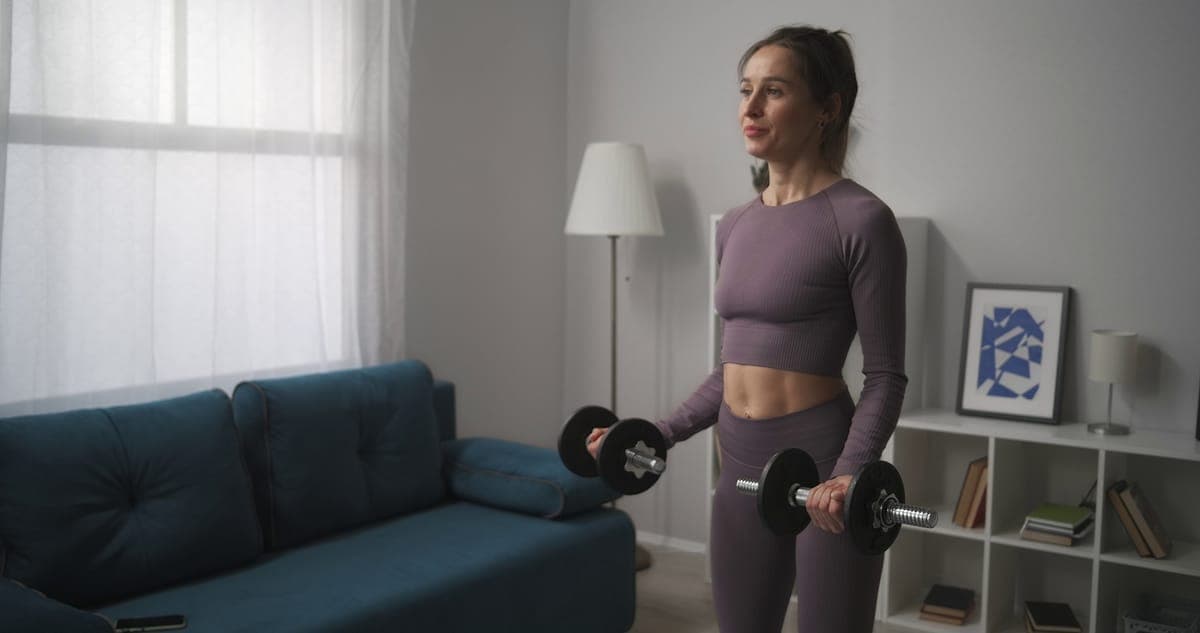
You don't need to be fit to start strength training. You need to start strength training to get fit. Here's why it's the right first investment.
Why Strength Training Is Different From Other Exercise
Most women's default approach to fitness is cardio: running, cycling, swimming, group fitness classes. Cardio has genuine benefits — it's good for cardiovascular health, can support weight management, and often improves mood and energy. There's nothing wrong with it.
But cardio is also what your body is already reasonably efficient at. Walking, taking the stairs, chasing after kids — all of these are aerobic activities. Adding more cardio on top of a baseline of daily movement doesn't substantially change your body's function.
Strength training is different because it changes your body in ways cardio cannot. It tells your muscles to grow. It tells your bones to strengthen. It expands the amount of energy your body burns at rest. For a woman who hasn't been exercising, even a modest strength training program produces dramatic changes in body composition, capability, and metabolic health.
The research is unambiguous: for women over 30, resistance training is the most impactful form of exercise for overall health outcomes. And the beauty of it is that you don't need to be fit to start. You don't need to work up to it. You can start today, from wherever you are.
The 'I've Never Been the Gym Type' Problem
The most common barrier to starting strength training isn't physical — it's social. Many women have spent years in gym environments that felt unwelcoming, intimidating, or simply not designed for them. The weights section is dominated by men. The mirrors feel judgemental. The group fitness classes are either too easy or too advanced, with nothing in between.
This is a real problem. Fitness content and gym culture has historically been built around men — their bodies, their goals, their social dynamics. Women who don't see themselves in that environment naturally disengage from it.
The solution isn't to push through the discomfort. It's to start somewhere that doesn't have those barriers. Home-based strength training with good instructions, no mirrors, no judgment, and no equipment beyond what you choose to bring — this is the starting point that most women who have been intimidated by traditional gyms actually need.
The FitForHer Foundations program was built for this. Not as a compromise version of 'real' fitness, but as the appropriate starting point for a body that is learning — or relearning — how to move with load.
What Strength Training Actually Does to Your Body
When you strength train, you create microscopic damage to your muscle fibres. Your body responds by repairing and reinforcing them — making them thicker, stronger, and more capable than before. This process is called hypertrophy, and it's the fundamental mechanism behind every strength gain you make.
But the benefits extend beyond the muscles themselves:
Bone density improves because bones adapt to the mechanical loading imposed by strength training. Every time your muscles contract against resistance, they pull on the bones they're attached to, stimulating bone-forming cells (osteoblasts) to lay down new bone matrix. For women over 40 — and particularly those in or approaching menopause — this is one of the most powerful tools available for maintaining skeletal integrity.
Joint health improves because stronger muscles better stabilise the joints they cross. The knees, hips, lower back, and shoulders all benefit from increased muscular support around them.
Insulin sensitivity improves because muscle is the primary tissue that absorbs glucose from the bloodstream, independent of insulin. More muscle means better blood sugar control.
Posture and balance improve because strength training develops the muscles responsible for keeping you upright, stacked, and stable.
Resting metabolic rate increases because muscle is metabolically expensive tissue — it burns calories just to maintain itself. The more muscle you carry, the more energy your body uses at rest.
The Most Important Concept: Progressive Overload
If there is one concept in strength training that matters more than all others, it's progressive overload. It sounds technical but it's simple: to keep getting stronger, you need to gradually increase the challenge on your muscles over time.
Your body adapts to the demands you place on it. If you do the same workout at the same resistance for months, your body has no reason to get stronger — it's already meeting the demand. To continue improving, you need to incrementally increase load, reps, sets, or decrease rest time.
This is why a well-designed beginner's program matters. It starts you at a load that is challenging but manageable, and then systematically progresses the stimulus over weeks and months. This systematic progression — not motivation, not Willpower, not having the perfect diet — is what drives results.
Most women who start a generic workout program they've found online or in a magazine don't have a progression plan. They repeat the same workout until it gets easy, then either add more exercises or increase duration — neither of which is the same as progressive overload. A structured program that tells you when and how to increase the challenge is what actually produces the adaptation you're training for.
What Two Sessions a Week Actually Looks Like
Two strength training sessions per week is the minimum effective dose for meaningful strength gains in beginners. Each session might look like:
A warm-up of 3-5 minutes of light movement — walking on the spot, gentle arm circles, body weight lunges with no weight.
Three to four compound exercises that target all the major muscle groups: squats (bodyweight or loaded), hip hinges (glute bridges, deadlifts), pushing exercises (push-ups, shoulder press), pulling exercises (rows, resistance band pulls), and core work ( planks, dead bugs).
Three sets of each exercise, with 60-90 seconds rest between sets.
A cool-down with gentle stretching.
Total time: 30-45 minutes per session.
This is not a lot of time. But because the stimulus is appropriately challenging, it's sufficient to drive meaningful adaptation. The key is consistency — showing up twice a week, week in, week out — not doing more than this when you're just starting.
As you progress, the sessions will naturally take longer as you add load, increase complexity, and require more recovery. But the starting point is accessible to almost anyone, regardless of current fitness level.
Why Foundations Exists as a Program
FitForHer Foundations was built specifically for women who are beginning from a starting point of no significant recent exercise history. Not because beginners need a 'lesser' version of fitness — but because the physiological and psychological needs of a woman who hasn't been training are different from those of a woman who has.
A beginner needs to: develop movement literacy and body awareness before adding load; establish a sustainable habit before optimising a program; build connective tissue tolerance gradually to reduce injury risk; develop confidence in their body's capability before pushing limits; and address foundational fitness factors (breathing, core function, joint mobility) before advanced training.
These needs aren't served by taking a general fitness program and doing it more slowly. They require a specifically designed progression. That is what Foundations is.
If you're reading this and thinking 'I haven't done anything regularly in years' or 'I wouldn't know where to start' — that's not a reason to delay. That's exactly what Foundations is designed for. You don't need to be fit to begin. You begin in order to get fit.
References
- Poehlman ET, Dvorak RV, DeNino WF, Brochu M, Ades PA. (2000). Effects of resistance training and endurance training on insulin sensitivity in nonobese, young women: a controlled randomized trial. J Clin Endocrinol Metab. 85(7):2463-2468.
- Rhea MR, Alvar BA, Burkett LN, Ball SD. (2003). A meta-analysis to determine the dose response for strength development. Med Sci Sports Exerc. 35(3):456-464.
- Westcott WL. (2012). Resistance training is medicine: effects of strength training on health. Curr Sports Med Rep. 11(4):209-216.
- Shojaa M, von Stengel S, Kohl M, Schoene D, Kemmler W. (2020). Effects of dynamic resistance exercise on bone mineral density in postmenopausal women: a systematic review and meta-analysis. Osteoporos Int. 31(8):1427-1444.
- Giovannucci EL, Rezende LFM, Lee DH. (2021). Muscle-strengthening activities and risk of cardiovascular disease, type 2 diabetes, cancer and mortality: a review of prospective cohort studies. J Intern Med. 290(4):789-805.
- Gonzalez-Galvez N, Moreno-Torres JM, Vaquero-Cristobal R. (2024). Resistance training effects on healthy postmenopausal women: a systematic review with meta-analysis. Climacteric. 27(3):296-304.
Common Questions
Do I need a gym to strength train?
No. You can build significant strength at home using bodyweight, resistance bands, or a pair of dumbbells. The research on strength adaptations to resistance training applies equally to home and gym settings. As you progress and want to lift heavier loads, joining a gym becomes more practical — but it's not a requirement to start.
Will I bulk up if I start lifting weights?
No — not in any meaningful sense. Bulking requires a significant calorie surplus and high testosterone. The hormonal environment in women (even premenopausal women) makes building large amounts of new muscle mass deliberately very difficult. What you will do is become stronger, more toned, and more capable — which is the actual goal.
I haven't exercised in years — is it too late to start?
No. Research consistently shows that previously sedentary adults of any age can make significant strength gains from resistance training — including women in their 60s, 70s, and beyond. The health benefits of starting from scratch at any age are substantial and well-documented. The best time to start was before now. The second best time is today.
What if I've had a bad experience at the gym before?
This is extremely common — particularly for women who have felt intimidated, judged, or unwelcome in gym environments. Starting with a home-based or small-group program removes that pressure entirely. The FitForHer Foundations program is designed to build confidence alongside capability — you don't need to know anything before you start.
How often should I strength train as a beginner?
Two sessions per week is the minimum effective dose for meaningful strength gains in beginners. Three sessions per week is optimal if you can manage it. The key principle is progressive overload — gradually increasing the challenge over time — not frequency or volume.
Jess Mizzi, CPT
Certified Personal Trainer and founder of FitForHer. Specialises in women's life-stage specific fitness — postnatal recovery, perimenopause, and menopause. About Jess →
Medical disclaimer: This article is for informational purposes only and does not constitute medical advice. Always consult a qualified healthcare professional before making changes to your exercise or nutrition programme.